Microstructures and Design Elements.
According to LiberatingStructures.com, all of our social interactions with others are organized by Microstructures. “They guide and control how groups work together. They shape our conversations and meetings.” – (https://www.liberatingstructures.com/design-elements/). Often, these microstructures become invisible to us because they become more and more ingrained and routine. In so doing, we become less intentional with the use of microstructures, and employ them largely on instinct rather than conscious intention.
Liberating Structures aims to bring conscious planning back into using these Microstructures by delineating them and clearly defining them, including pictograms, a breakdown of steps in using the microstructure, and outlining the purpose of using various liberating structures. It forces us to be much clearer on our purpose in order to decide which one or which combination to use.
As Liberatingstructures.com states,
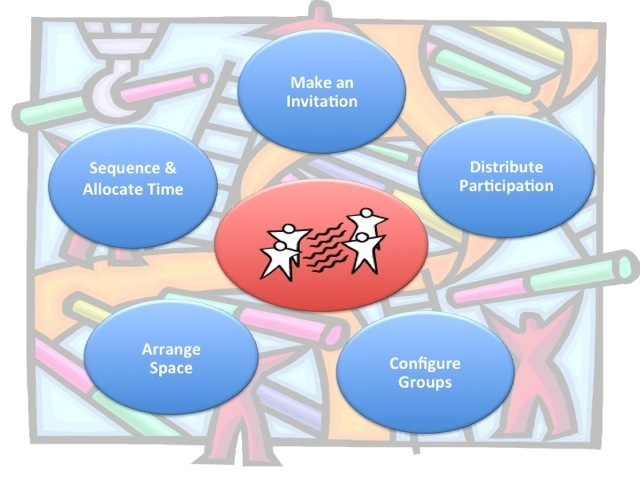
Five elements define the underlying design of all microstructures—conventional or liberating. We call them design elements because you can make choices about them based on what you want to accomplish. The five design elements for a conventional presentation or lecture are illustrated below:
- a structuring invitation (listen to me);
- how the space is arranged and what materials are needed (rows or U facing presenter, screen, projector and PPT slides);
- how participation is distributed (nearly 100% of total time for presenter);
- how groups are configured (one group, one presenter); and,
- a sequence of steps and time allocation (presentation for most of time; possibly Q&A for balance of time).
A) What? So what? Now what? (W cubed)
After a shared experience, ask, “WHAT? What happened? What did you notice, what facts or observations stood out?” Then, after all the salient observations have been collected, ask, “SO WHAT? Why is that important? What patterns or conclusions are emerging? What hypotheses can you make?” Then, after the sense making is over, ask, “NOW WHAT? What actions make sense?”
- If needed, describe the sequence of steps and show the Ladder of Inference (see below). If the group is 10–12 people or smaller, conduct the debrief with the whole group. Otherwise, break the group into small groups.
- First stage: WHAT? Individuals work 1 min. alone on “What happened? What did you notice, what facts or observations stood out?” then 2–7 min. in small group. 3–8 min. total.
- Salient facts from small groups are shared with the whole group and collected. 2–3 min.
- If needed, remind participants about what is included in the SO WHAT? question.
- Second stage: SO WHAT? People work 1 min alone on “Why is that important? What patterns or conclusions are emerging? What hypotheses can I/we make?” then 2–7 min. in small group. 3–8 min. total.
- Salient patterns, hypotheses, and conclusions from small groups are shared with the whole group and collected. 2–5 min.
- Third stage: NOW WHAT? Participants work 1 min. alone on “Now what? What actions make sense?” then 2–7 min. in small group. 3–8 min. total.
- Actions are shared with the whole group, discussed, and collected. Additional insights are invited. 2–10 min.
B) 1,2,4, All!
Ask a question in response to the presentation of an issue, or about a problem to resolve or a proposal put forward (e.g., What opportunities do YOU see for making progress on this challenge? How would you handle this situation? What ideas or actions do you recommend?)
- Silent self-reflection by individuals on a shared challenge, framed as a question (e.g., What opportunities do YOU see for making progress on this challenge? How would you handle this situation? What ideas or actions do you recommend?) 1 min.
- Generate ideas in pairs, building on ideas from self-reflection. 2 min.
- Share and develop ideas from your pair in foursomes (notice similarities and differences). 4 min.
- Ask, “What is one idea that stood out in your conversation?” Each group shares one important idea with all (repeat cycle as needed). 5 min.
C) Min Specs
- In the context of a challenging activity, a new initiative, or a strategic bottleneck, invite the participants to first generate the entire list of all the do’s and don’ts that they should pay attention to in order to achieve a successful outcome. This is the list of maximum specifications (Max Specs).
- After the list of Max Specs has been developed, ask the participants to reduce it to the absolute minimum needed to achieve their purpose. Invite them to sift through the list one item at a time and eliminate every rule that gets a positive answer to the question, “If we broke or ignored this rule, could we still achieve our purpose?”
- Generate the list of all must-do and must-not-do activities (Max Specs), at first alone for one minute then consolidate and expand in the small group for five minutes. Make list as complete as possible in a short time. 6 min.
- Each small group tests each spec on its Max Spec list against the purpose statement. If the spec can be violated and the purpose still achieved, the spec is dropped from the list. 15 min.
- Do a second round if needed. 15 min.
- Compare across small groups and consolidate to the shortest list. 15 min.